
Kala
    Kala
    Kala

    How to Increase Customer Lifetime Value on Shopify

    Kaloyan ChirovKaloyan Chirov, Founder, Kala Partners

    Last Updated: March 2026 · 14 min read

    Most Shopify store owners measure success by sales and revenue. These are useful signals, but they only show you a snapshot of the present. They don't tell you whether the business is actually growing in a durable, profitable way. Customer Lifetime Value (CLV) does. It tells you how much revenue a single customer generates across their entire relationship with your brand.

    Explore Our Services

    What is Customer Lifetime Value and Why Does It Matter?

    Customer Lifetime Value is the total net profit your business expects to earn from a customer over the entire duration of your relationship with them. It shifts your focus from 'how much did we make this month?' to 'how much is this customer worth to us over time?' That shift in thinking is what separates stores that plateau from stores that scale.

    • Acquiring a new customer costs 5–7x more than retaining an existing one.
    • Yet most Shopify stores invest the majority of their marketing budget in acquisition and almost nothing in retention.

    When you know your CLV, you can answer the questions that actually drive profitable growth:

    • How much can we afford to spend acquiring each customer?
    • Which customer segments are worth investing in?
    • Which marketing channels bring the highest-value customers, not just the most clicks?
    • What is the real impact of improving our retention by 10%?

    The LTV:CAC Ratio: your most important benchmark

    The ratio of Customer Lifetime Value to Customer Acquisition Cost (LTV:CAC) is arguably the single most important metric in ecommerce. A healthy ratio is 3:1 or higher. If you spend €1 to acquire a customer, that customer should generate at least €3 in profit over their lifetime.
    How to Calculate Customer Lifetime Value

    Before you can improve CLV, you need to measure it accurately. The core formula is straightforward:

    CLV = Average Order Value × Purchase Frequency × Average Customer Lifespan

    Here is what each component means and how to find it in Shopify:

    • Average Order Value (AOV): Total revenue ÷ total number of orders. Find this in Shopify Reports > Sales.
    • Purchase Frequency: Total orders ÷ total unique customers (over the same period). Shows how often the average customer buys.
    • Average Customer Lifespan: The average time between a customer's first and last purchase. Use Shopify's Customer reports or a tool like Littledata for more precision.

    A practical example

    Imagine a Shopify store selling sports apparel:

    • AOV: €65
    • Purchase frequency: 3 orders per year
    • Average customer lifespan: 5 years
    CLV = €65 × 3 × 5 = €975 per customer

    If your profit margin is 40%, that's approximately €390 profit per customer. If you're spending €50 to acquire each one, your profit-to-acquisition ratio is 7.8:1, exceptional by any standard.

    Simple CLV vs Predictive CLV

    The formula above uses historical averages and assumes consistent behaviour across all customers. This is a useful baseline, but it has limits, different marketing strategies, product changes, or market conditions all affect future behaviour.

    Predictive CLV uses machine learning to model future customer value based on individual behaviour signals: purchase history, browsing patterns, engagement with email, and more. It's more accurate but requires more sophisticated tooling. Most growing Shopify brands start with the historical model and move to predictive as their data matures.

    RFM Segmentation: CLV by customer type

    Not all customers are equally valuable. RFM analysis (Recency, Frequency, Monetary) helps you segment your customer base to understand which groups have the highest CLV and which are at risk of churning.

    • Recency: When did this customer last buy? Recent buyers are more likely to buy again.
    • Frequency: How many times have they bought? Frequent buyers signal loyalty.
    • Monetary: How much have they spent in total? High-spend customers drive disproportionate revenue.

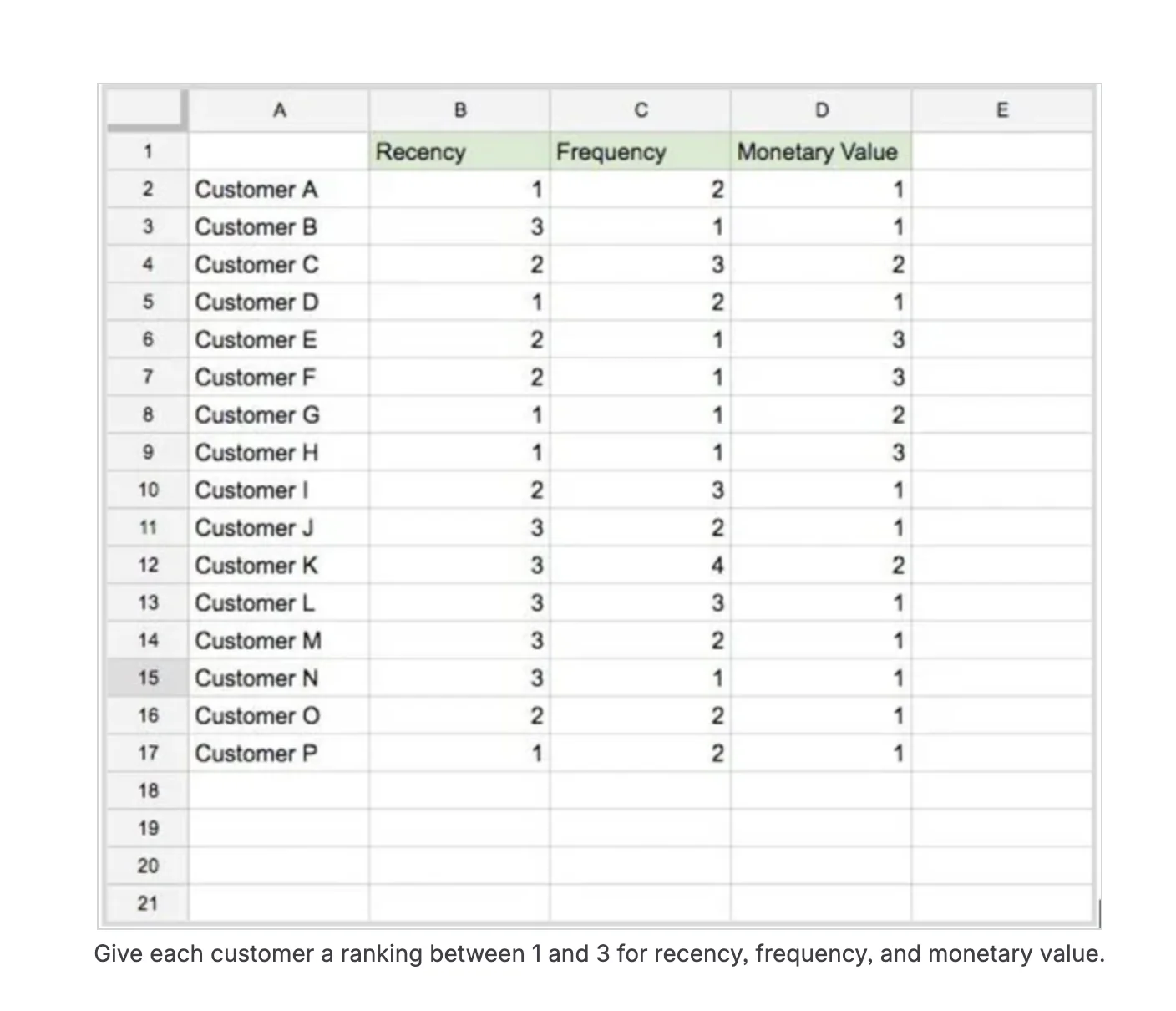
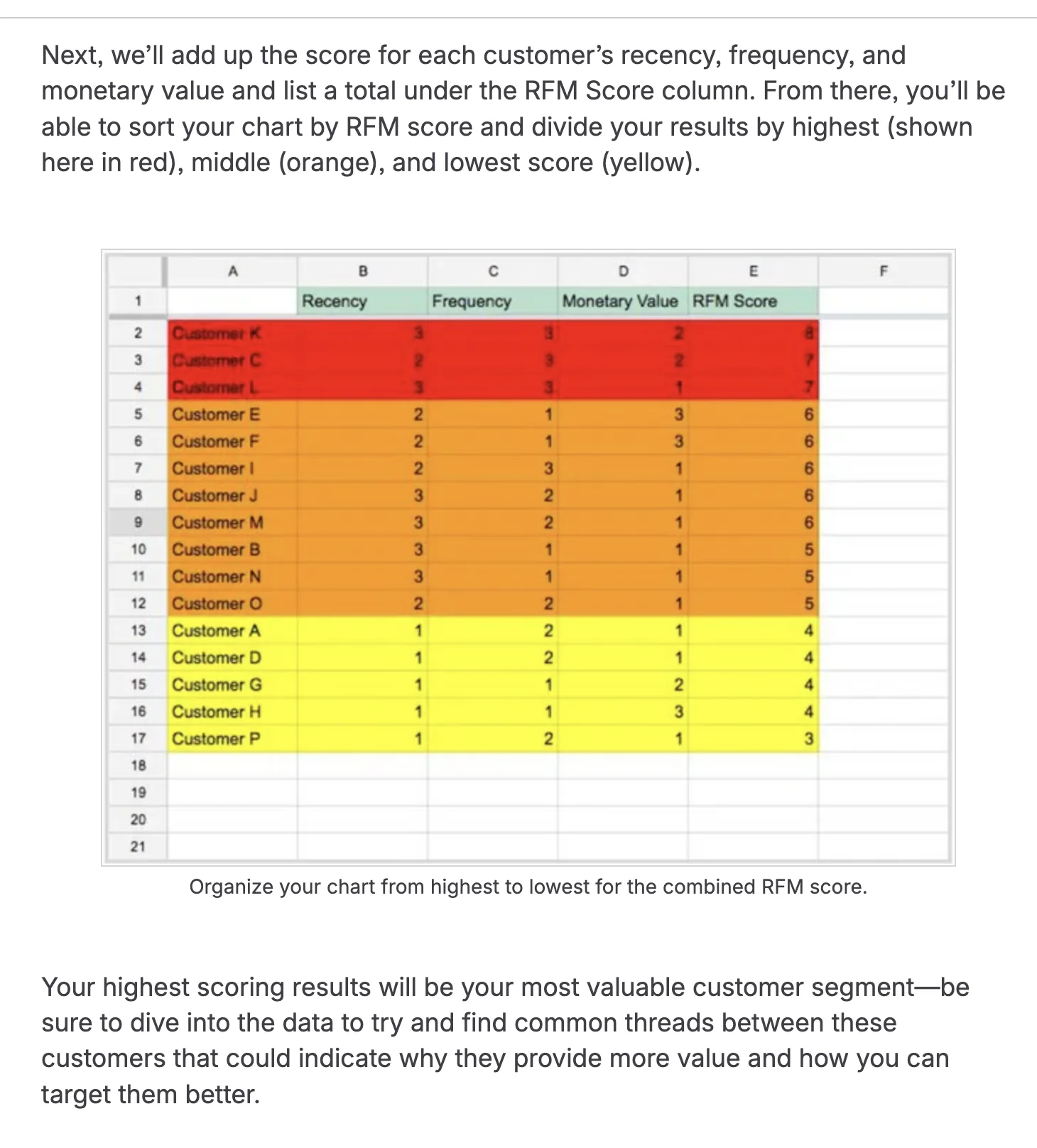
    Score each customer 1–3 on each dimension. Your highest-scoring segment (3-3-3) are your VIPs. Your lowest are candidates for win-back campaigns or should be deprioritised. Shopify's built-in Reports > Sales by Customer Name gives you everything you need to run this analysis.

    RFM segmentation table, raw scores
    Give each customer a ranking between 1 and 3 for recency, frequency, and monetary value.
    RFM segmentation table, scored and sorted
    Organise your chart from highest to lowest for the combined RFM score.

    Personalisation and Customer Segmentation

    The single most consistent driver of CLV improvement we've seen across client stores is personalisation, treating different customers differently based on their actual behaviour, not just their demographics.

    Demographic segmentation ('women aged 25–34') is a starting point. Behavioural segmentation is where the money is.

    The questions to ask for behavioural segmentation:

    • Are they a first-time buyer or a returning customer?
    • Do they stick to one product category or shop broadly?
    • Are they price-sensitive or do they gravitate to premium options?
    • Do they engage with email, or do they ignore it?

    With this level of segmentation, your messaging becomes dramatically more relevant. A high-value customer who has bought three times in six months needs a completely different experience from a first-time buyer still weighing up whether to complete their order.

    Shopify Flow allows you to automate segmentation based on purchase behaviour, spend history, and email engagement, then trigger specific email sequences, discount offers, or product recommendations for each segment.

    Personalised product recommendations alone, not generic 'Related Items', but genuinely tailored suggestions, typically increase repeat purchase rates by 10–30% depending on implementation quality. That directly compounds into a higher CLV.

    Building a Loyalty Programme That Works

    Loyalty programmes are one of the most proven tools for building CLV. When structured correctly, they create psychological stickiness that encourages repeat purchases and increases spend over time.

    The three main loyalty models

    • Points-based programmes: Customers earn points per purchase and redeem them for discounts or products. Simple to understand, easy to implement with apps like Smile.io or LoyaltyLion, and effective at driving incremental purchases.
    • Tiered programmes: Customers progress through levels (Bronze, Silver, Gold) based on cumulative spend. Higher tiers unlock exclusive benefits: free shipping, early access, VIP support. Tiers create powerful psychological incentives.
    • Paid membership: Customers pay an upfront annual or monthly fee in exchange for ongoing benefits. This model works well for stores with a higher AOV where members can quickly recoup their membership cost through exclusive discounts.

    Research shows that 80% of loyalty programmes report a positive ROI, with an average return of 4.9x. For every €1 invested in your loyalty programme, you generate approximately €4.90 in additional revenue.

    Popular Shopify loyalty apps include Smile.io, LoyaltyLion, and Yotpo. Each integrates directly with your store, manages customer accounts, tracks points, and triggers automated emails when customers earn or redeem rewards.

    Subscription Models and Recurring Revenue

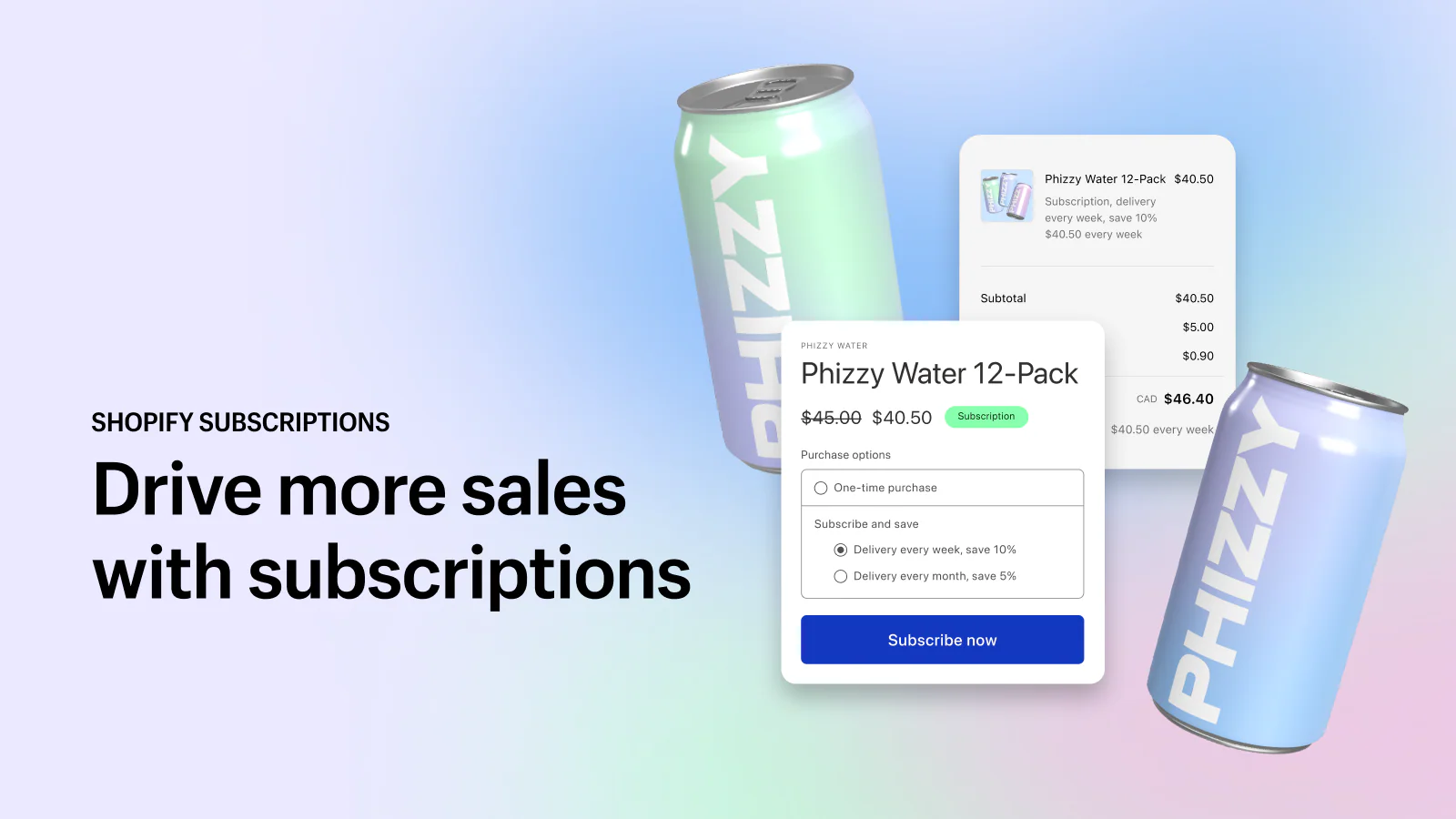
    If loyalty programmes are the first major CLV lever, subscriptions are the second, and arguably the most powerful structural shift you can make. Subscriptions fundamentally change the economics of your business by creating predictable, recurring revenue streams.

    Subscription customer (€25/month): €300/year vs Transactional customer (3 × €65): €195/year

    Over a five-year customer lifespan, that subscription customer generates €1,500 in revenue vs €975 from a transactional customer, a 54% increase in CLV from one strategic decision.

    The three subscription models

    • Replenishment subscriptions: Customers receive consumables on a recurring schedule, coffee, supplements, pet food, skincare.
    • Curated product subscriptions: Customers receive curated selections at regular intervals. The appeal is discovery and variety.
    • Access subscriptions: Customers pay for access to exclusive products, content, or experiences, early access, exclusive sales, VIP support.

    Shopify subscription apps: Recharge is the market leader with deep Shopify integration. Loop offers a modern interface and strong customer portal UX. Appstle combines subscription management with post-purchase experience optimisation.

    Key retention tactic: Offer pause and skip options instead of forcing cancellations. We've seen pause options reduce churn by 20–30% in client stores.

    Email and SMS Retention Strategies

    Email and SMS are your most direct channels for driving repeat purchases, and therefore the most direct lever on CLV.

    The post-purchase email sequence

    The 72 hours after a customer completes their first purchase are the highest-value window you have. A strategic sequence here significantly increases the probability of a second purchase.

    The sequence that works:

    • Order confirmation + shipping update (transactional, expected)
    • Product tips or care guide, help customers get the most from what they bought
    • Complementary product recommendation, relevant cross-sell, not a generic upsell
    • Review request with a small incentive, builds social proof
    • First repeat-purchase offer, timed to your typical repurchase cycle

    Executed well, this sequence increases second-purchase rates by 15–25%. Klaviyo is the platform most high-performing Shopify brands use for this.

    Win-back campaigns

    Win-back campaigns target customers who haven't purchased in 90–180 days. These campaigns re-activate dormant relationships with special offers, new product highlights, or curiosity-driven messaging. Win-back emails typically achieve 20–40% open rates and can bring back 5–15% of inactive customers.

    SMS marketing

    SMS has a 98% open rate within minutes of delivery. This makes it ideal for time-sensitive offers, flash sales, or urgency-driven reminders. An SMS reminder 24 hours before a limited-availability sale can drive 10–20% additional purchases from opted-in customers.

    Key principle: segment your SMS list just as carefully as your email list. The same message to all customers is both less effective and more likely to generate unsubscribes.

    Upselling, Cross-Selling, and Increasing AOV

    Since CLV = AOV × Purchase Frequency × Customer Lifespan, every increase in AOV compounds directly into CLV. A 10% improvement in AOV is a 10% improvement in CLV, assuming frequency and lifespan hold constant.

    Upselling = encouraging customers to upgrade to a higher-tier or more expensive version of what they're buying.

    Cross-selling = recommending complementary products. If they're buying running shoes, you cross-sell moisture-wicking socks or a running belt.

    The highest-converting moment for upsells is immediately after someone decides to buy, right before or right after checkout. A well-placed post-purchase offer can increase AOV by 10–20%. Apps like Rebuy and Bold specialise in this.

    Product bundling is another powerful AOV driver. A curated bundle priced at €120 vs €140 separately increases AOV while delivering genuine value. Bundles also tend to carry higher margins because they're positioned as curated solutions.

    A €5 AOV increase across 1,000 regular customers is €5,000 in additional annual revenue. Over a 5-year customer lifespan, that's €25,000 from one strategic change.

    Customer Experience and Support

    CLV ultimately depends on customer satisfaction and emotional loyalty. You can have perfect email sequences and loyalty programmes, but if the customer experience is poor, customers will leave regardless.

    Checkout and returns

    A frictionless checkout is non-negotiable. Customers who abandon checkout due to complexity or trust issues represent both lost revenue and higher future acquisition costs. Implement guest checkout, progress indicators, transparent shipping costs, and trust signals throughout the checkout flow.

    Returns experience matters equally. A generous, easy return policy actually increases CLV, customers who trust that they can return a product are more likely to buy in the first place, and the positive experience of a well-handled return builds long-term loyalty.

    Measuring and Tracking CLV Over Time

    If you're not tracking CLV consistently, you're operating without a dashboard. Measurement creates accountability and tells you which strategies are actually working.

    The core KPIs

    • Average Order Value (AOV): track monthly and by segment
    • Purchase Frequency: total orders ÷ unique customers over 12 months
    • Churn Rate: what % of customers who bought in the last 12 months haven't bought in 90 days?
    • Retention Rate: what % of customers who bought once return within 12 months?
    • Customer Lifespan: average time between first and last purchase

    Quarterly CLV reporting

    Calculate CLV for customers acquired in each quarter, then track how each cohort develops over time. If cohort retention is declining quarter-on-quarter, that's a clear signal to invest in retention. If it's improving, you're building stronger customer relationships.

    Setting CLV improvement goals

    Break your CLV target into component levers. If your current CLV is €975 and you want to reach €1,170 (a 20% improvement):

    • 8% AOV increase through loyalty discounts and bundling
    • 5% purchase frequency increase through email campaigns and product education
    • 15% retention improvement through loyalty programme and experience optimisation

    Each lever is independently actionable and measurable. A/B test your retention strategies systematically; we've seen brands improve retention rates by 8–12% in a single year through disciplined testing.

    FAQs

    What is a good CLV for a Shopify store?

    There's no universal benchmark, it varies significantly by category, AOV, and business model. The most useful benchmark is your own LTV:CAC ratio: aim for 3:1 or higher.

    How do I find my CLV in Shopify?

    Go to Reports > Customers in your Shopify admin. You'll find average order value and purchase frequency data. For a complete CLV calculation, you'll need to factor in average customer lifespan.

    What is the difference between CLV and LTV?

    The terms are used interchangeably in ecommerce. Both refer to the total profit a customer generates across their relationship with your brand.

    How long does it take to improve CLV?

    Post-purchase email sequences and checkout optimisations can show measurable results within 30–60 days. Loyalty programmes and subscription models typically show meaningful impact within 90–180 days. Retention rate improvements compound over 6–18 months.

    Do loyalty programmes really increase CLV?

    The data is clear: 80% of loyalty programmes report positive ROI with an average return of 4.9x. Tier-based programmes with real VIP benefits consistently outperform simple points schemes.

    Which Shopify apps help increase CLV?

    • Klaviyo: email and SMS automation with deep Shopify integration
    • Smile.io / LoyaltyLion / Yotpo: loyalty programme management
    • Recharge / Loop / Appstle: subscription management
    • Rebuy / Bold: post-purchase upsell and cross-sell
    • Nosto / Klevu: AI-powered personalised product recommendations
    • Littledata / GA4: advanced CLV tracking and cohort analysis

    At Kala, we've helped Shopify brands, from emerging DTC labels to established multi-market stores, build exactly these systems. If you want to understand where your store's CLV gaps are and what to prioritise first, get in touch with the team.

    Get in Touch